
Mitigation Strategy
Elevate or abandon lowest interior floor
Overview
Elevation is a mitigation technique in which a structure, existing or new, is raised high enough that the lowest floor and all plumbing, electrical systems, and ductwork are at or above the Design Flood Elevation to prevent floodwaters from damaging the structure and its contents. There are generally five types of elevated foundations: on extended solid perimeter foundation walls, on piers, on posts, on columns, and on piles. Two variations to achieve elevation are: on engineered fill or by abandoning the lowest interior floor (as described here). Depending on your structure’s foundation, location, and other factors, such as the likelihood of other hazards occurring, one elevation type might be a more effective strategy to protect your structure – and pocketbook – than another.

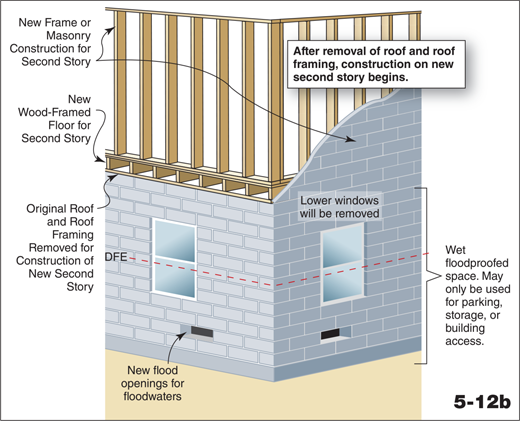
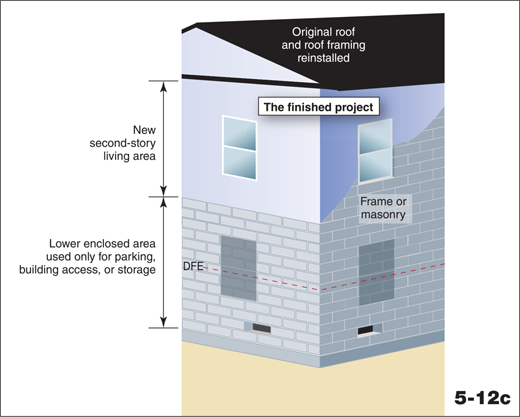
If you are unable to elevate your structure off of its original foundation, find out whether your lowest interior floor can be elevated or abandoned. This elevation technique is also known as “lower-level abandonment,” “first-floor abandonment,” “interior elevation,” or “second-story conversion.”
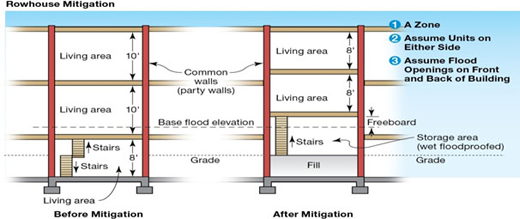
If your building is multiple stories high and the Base Flood Elevation (BFE) is above the ground-floor level, you can use the next highest floor level above the BFE as a living area and convert the original lowest floor to an open foundation or enclosed area for parking, storage, or building access. Converting to an open foundation or wet floodproofed enclosed area involves moving all contents to a higher floor; replacing or modifying the original walls; removing any interior finishes, and replacing them with flood damage-resistant materials; relocating or elevating all mechanical, electrical, and plumbing equipment to or above the BFE; and, if necessary, adding flood openings. All converted areas must remain unfinished, and you may be required to sign a “non-conversion agreement” to that effect. To offset the living space lost to the conversion, you may be able to construct an addition to the building, convert an attic, or add another story to the building, depending on your structure, lot, and budget.

In some buildings, the first-floor ceiling may be high enough that the contents can be raised onto an elevated floor above the design flood elevation without relocating to a higher floor.
If your building includes a basement, it will need to be filled with compacted soil, sand, or pea gravel at least up to ground level, and then covered with a vapor barrier or concrete cap that allows water to drain.
An annual inspection of the entire site is recommended in order to ensure that all modifications, from flood vents to water-resistant materials, are operational and have not been affected by prior flooding.

Property Characteristics
Property Scale
Single Property
Real Estate Type
Single-family residence
Business
Government building
Foundation Type
Slab-on-Grade
Crawlspace
Basement
Property Location
Any
Past Flood Depth
Moderate
Shallow
Deep
Debris Flow Potential
Yes
Structure Condition
Fair-to-excellent condition
Implementation Factors
Annual Maintenance Required
Low
Action Required If Flood Is Imminent
No, Passive
Relative Cost
$$$
$$$$
$$$$$
Level of Effort
Professional

Next Steps:
- Consult with your local floodplain manager to determine the height to which you should elevate to be compliant with local floodplain ordinances and zoning codes – and what permits are necessary for converting the living space or constructing an addition.
- Engage a registered design professional to determine if abandoning the lower living space would effectively place the remaining living areas above the Base Flood Elevation to make the structure compliant with local floodplain ordinances. If so, have them design and certify the necessary modifications to the building, from the conversion of the lower habitable areas to the installation of flood vents, to ensure that the remaining living space is located above the design flood elevation and that the building is properly anchored to resist flotation, collapse, and lateral movement.
- Hire a qualified contractor to construct and install the modifications.
- New landscaping can be added, if necessary.
Special Considerations:
- If your structure is in less than fair condition, this mitigation option type is not recommended. The only mitigation option types recommended for structures in less than fair condition are acquisition, demolition, and the purchase of flood insurance or business interruption insurance.
- Ensure compliance with all applicable National Flood Insurance Program (NFIP) requirements and local building codes.The NFIP sets minimum standards and allows individual communities to adopt their own additional or more stringent requirements via local floodplain management ordinances, regulations, and laws.
- If your building sustained substantial damage during a recent flood event, you may be required to bring it into compliance with NFIP and local floodplain management regulations.
- Be careful not to redirect water flow from your property onto another property. No adverse impact (NAI) floodplain management is an approach that ensures the action of any property owner, public or private, does not adversely impact the property and rights of others. NAI calls for any adverse impact caused by a project to be mitigated as part of the project. By following NAI principles, you can: prevent flooding from increasing or damaging others; see a reduction in flood losses over time; and avoid challenges and lawsuits over causing or aggravating a flood problem.
- Contact a local flood insurance representative to learn more and get a quote, if you do not already have flood insurance. (Most homeowner’s insurance policies do not cover flood damage.)
- Renters and those who own specific types of property may be limited in which mitigation options they can undertake or have different requirements to which they must adhere. If you are a renter or own any of the following listed property types, click through to learn more: Renter; Unit in a multifamily residence; Manufactured home; Farm/ranch; Historic property; New construction.
Reduce Flood Risk
https://www.reducefloodrisk.org/mitigation/elevate-or-abandon-lowest-interior-floor/
Printed: 06/13/2026
 EN
EN  ES
ES