
Mitigation Strategy
Apply waterproof sealants or membranes
Overview
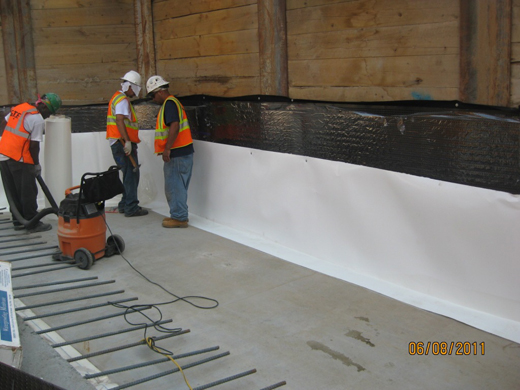
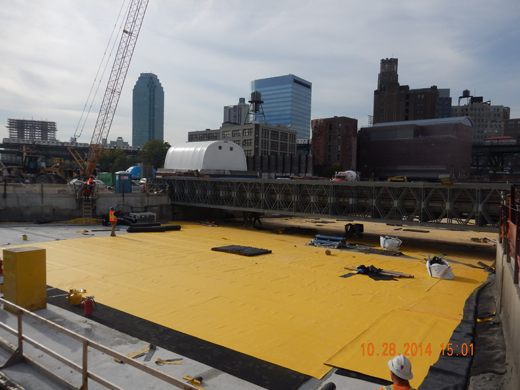
When floodwater comes into contact with building materials that are not water-resistant, the water may penetrate through the material into the interior of the building, causing significant damage, decay of material, and possibly mold growth. Waterproof sealants and membranes can be applied to the exterior of buildings that may come into contact with floodwater, to make them watertight and keep floodwaters from seeping into the building. Types of sealant systems include but are not limited to wall coatings, waterproofing compounds, impermeable sheeting and/or supplemental layers of masonry or cast-in-place concrete. Temporary protection can be achieved by hanging a water-resistant polyethylene sheeting from the exterior walls.
Waterproof sealants are usually made of tar, hydraulic cement, bitumen, the petroleum-based liquid binder that holds asphalt together, and applied directly to the surface of the building’s exterior or into the holes through which electrical, mechanical, plumbing, or drainage systems enter the building. Sealants and membranes are generally only applied to a height of up to three feet aboveground unless the wall has been analyzed by a licensed engineer.

The success or failure of waterproof sealants depends on the expected duration of the flood, how fast the water is expected to move, and if debris or ice flow is expected. They are most successful when used in areas that have slow-moving, shallow flooding with no debris or ice flow. They are more likely to fail if used in areas: of deep, fast-moving flow; where flooding that lasts for more than 12 hours; or at risk of debris or ice flow.
If using polyethylene sheeting, the material may be purchased in rolls and hung from the exterior walls with hooks or nail strips. The walls should be deemed structurally sound for resisting the weight and force of the floodwater. The material should extend outward from the structure several feet and be held down with sandbags or something comparable.
Prolonged flooding exerts extreme pressure on foundation walls, and, regardless of sealants or membranes, can cause walls to collapse. Additionally, seepage can occur when the sealant is penetrated by debris or ice; even prolonged exposure to floodwaters can cause failure of the sealant. As with any dry floodproofing method, some seepage should always be anticipated and prepared for with a well-constructed dewatering system. An annual inspection of all waterproof materials is recommended in order to ensure that the product is intact, without any cracking, shrinkage, or loss of adhesiveness or connectivity to the exterior walls.

Property Characteristics
Property Scale
Single Property
Real Estate Type
Single-family residence
Business
Government building
Foundation Type
Slab-on-Grade
Crawlspace
Basement
Property Location
Non-coastal
Past Flood Depth
Shallow
Debris Flow Potential
No
Structure Condition
Fair-to-excellent condition
Implementation Factors
Annual Maintenance Required
Low
Action Required If Flood Is Imminent
No, Passive
Relative Cost
$$
$$$
$$$$
Level of Effort
Professional
DIY

Next Steps:
- If you do not already know, contact your local government to learn more about your property’s flood history and base flood elevation, and to determine what federal, state and local permitting, code or ordinance requirements you will need to follow, before any work starts. If you are not sure who to talk to, check out our “who to contact” page.
- Consult a design professional to make sure that the application of sealants or membranes is the right solution for your building. Have them determine the structural soundness of your building, including the walls and the floor slab. Are they able to resist anticipated floodwaters and flood-related loads? If so, find out what waterproofing materials, coatings, or membranes are most appropriate to apply to your exterior walls.
- Before you begin application, examine your building’s exterior to determine where electrical, mechanical, plumbing, or drainage components enter or exit the building. Are the holes potential points of entry for floodwaters?
- Apply waterproof material, coating, or membranes to the building’s exterior and any points of entry for utilities that you have found. You can do this yourself or hire a professional. It is recommended to hire a professional, especially when sealing holes around electrical, mechanical, plumbing, or drainage systems. In fact, it may be required – check with your local utility firm. (Application in the vicinity of electrical or mechanical equipment may also require certification by a qualified agent to ensure that the sealing device/product is adequate for sealing the material at any entry points for utility components in the building.)
Special Considerations:
- This mitigation option type is not recommended in areas with floodwaters of a depth greater than three feet or a high velocity, where water moves at more than 6 feet per second. If you do not know the projected flood velocity around your property, check with your local floodplain manager.
- Penetration sealing devices can be certified.Check to see if the product you are looking to install meets the ANSI 2510 standard.
- Ensure compliance with all applicable National Flood Insurance Program requirements and local building codes. The NFIP sets minimum standards and allows individual communities to adopt their own additional or more stringent requirements via local floodplain management ordinances, regulations, and laws.
- Contact a local flood insurance representative to learn more and get a quote, if you do not already have flood insurance. (Most homeowner’s insurance policies do not cover flood damage.)
- If your building sustained substantial damage during a recent flood event, you may be required to bring it into compliance with NFIP and local floodplain management regulations.
- If your building or structure is in less than fair condition, this mitigation option type is not recommended. The only mitigation option types recommended for structures in less than fair condition are acquisition, demolition, and the purchase of flood insurance or business interruption insurance.
- Renters and those who own specific types of property may be limited in which mitigation options they can undertake or have different requirements to which they must adhere. If you are a renter or own any of the following listed property types, click through to learn more: Renter; Unit in a multifamily residence; Manufactured home; Farm/ranch; Historic property; New construction.
Reduce Flood Risk
https://www.reducefloodrisk.org/mitigation/apply-waterproof-sealants-or-membranes/
Printed: 06/10/2026
 EN
EN  ES
ES